Friday, August 31, 2012

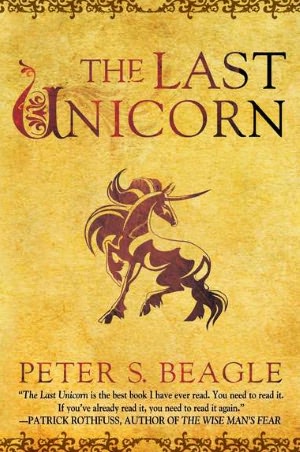
Book Review #12: The Last Unicorn

This month's Animal Fantasy Book Review is Peter S. Beagle's classic novel, The Last Unicorn.  Equine novels are near and dear to my heart, as you could probably guess from my horse-themed manuscript, The Beast of Bannock.  Ordinarily, I discuss recent animal fantasies in my book review feature, but classics undoubtedly have their place in today's reading population, too.  Just as students study Steinbeck and Salinger in the classroom, there is much to be learned from classic animal fantasy works.  It's good for writers to know what's selling in today's market, but it's equally important to know what books played a part in shaping the genre.  If you aren't familiar with The Last Unicorn yourself, here's the summary from Goodread's website:   

The unicorn discovers that she is the last unicorn in the world, and sets off to find the others. She meets Schmendrick the Magician--whose magic seldom works, and never as he intended--when he rescues her from Mommy Fortuna's Midnight Carnival, where only some of the mythical beasts displayed are illusions. They are joined by Molly Grue, who believes in legends despite her experiences with a Robin Hood wannabe and his un-merry men. Ahead wait King Haggard and his Red Bull, who banished unicorns from the land.

I will start off by noting that I have never seen the animated version of The Last Unicorn, so I came into this book with no expectations or prior knowledge of the story.  (Heck, I didn't even know the movie was originally a book until I saw it on Goodreads!)  I am happy to say the book is an enchanting read, and one that you won't soon forget.  The characters are varied and deep, the plot magical, and the unicorn as bewitching and aloof as I imagine one might be in real life.  (Wouldn't you be aloof, too, if you were the most beautiful, immortal creature in the world?)  What I admire most about this book, though, is the writing itself as well as how Beagle balances the characters in the story.

Told from the third-person perspective, The Last Unicorn switches mainly between the titular, unnamed unicorn, the magician Schmendreck, and their companion Molly Grue's point of views.  Each sees the world differently, giving their separate flavors to the story.  The two main human characters are affected by the unicorn in their own ways, bringing the equine character to life in a way she couldn't do on her own.  As I mentioned above, the unicorn is aloof, and it can be hard to feel close to an emotionally-distant character you don't know very well.  But the respect, awe, jealousy, despair and other raw emotions that the unicorn brings out in Molly and Schmendrick make you root for the equine and her quest--as well as the large part the humans play in it.  And for all her beauty and grace, the unicorn is genuinely pitiable, as Beagle presents from the very first line: "The unicorn lived in the lilac wood, and she lived all alone."  She tugs at your heartstrings before you even find out just how alone she really is.  Beagle could have chosen just the unicorn or the magician to tell this tale, but I think it is only with the twining of all the characters' viewpoints that the full story can truly shine.

The best part about this book, though, is the gorgeous writing.  I can honestly say this is probably the most beautiful book I have ever read.  Every page has thought-provoking metaphors, unique smiles, and breathtaking, lyrical word choices.  I was constantly re-reading paragraphs, savoring phrases and wallowing in the images.  At one point, the villainous King Haggard shouts at the unicorn, "What's the matter with your eyes? They are full of green leaves, crowded with trees and streams and small animals...I want to know why there are fox cubs in her eyes."  Leaves and trees and fox cubs in someone's eyes?  I have never thought to describe a character's eyes like that!  But it is a stunning image that stayed with me long after I read that passage.  The entire book is just like that, with writing so beautiful your heart will sigh and ache with every page.

If you love reading classic fantasy literature or have an affinity for equine stories, then this book is definitely for you.  And if you are a lover of words themselves, then you owe it to yourself to read this beautiful book.  By reading The Last Unicorn, you'll see how different it is from the current fantasy books that are being published for modern young readers, but you'll also find common threads that still make it a meaningful book today.  I don't think you'll be disappointed, and it may just inspire you to write a little more poetically.

To the best of my research, Peter Beagle does not have an author website, but there is plenty of information about him and his other works on the web.  If you read The Last Unicorn, do let me know.  I'd love to hear what you think!

Happy reading!  :) 

Note: Summary is from Goodreads and the jacket art image is from barnesandnoble.com.

Wednesday, August 29, 2012

COSCBWI August 2012: Query Letters


This month's COSCBWI meeting was all about query letters.  Led by our Assistant Regional Advisor, Andrea Hall, and yours truly, we first had a discussion on query letters do's and dont's, as well as formatting and standard guidelines.   We then critiqued members' query letters as a group, giving constructive feedback for each volunteer.

A quick Google search will bring you tons of pages on the basics of query letter writing, so I won't go into that here.  Instead, here are some tips we discussed for you to consider once you have your ideas on paper:

-Be professional.  You want to present yourself and your book in the very best light possible.

-Have some buddies read it for errors.  You definitely don't want to send out a letter with typos!

-Be sure to follow the agent's guidelines.  Many literary agencies specify what they want included in your letter, as well as attachment preferences, etc., so pay close attention to what they ask of you.

-Try to personalize your letter for each agent you submit to.  If Agent A loves friendship stories, emphasize the relationships in your manuscript.  If Agent B likes humor, emphasize what is funny about it.  You can do this just by tweaking your letter instead of writing a dozen different ones.  (Note: DO NOT lie, though.  Only emphasize what is truly in your story.  If there is no romance plot in your manuscript, don't compare it to Romeo & Juliet.)

-Do include relevant information in your bio section.  If you're a Paleontologist writing a book about dinosaurs, that's a great thing to point out.

-Agents are so busy and receive such a high volume of queries that is isn't in your best interest to submit your manuscript exclusively to any one agent.  (You could wait anywhere from one hour to several months for a response.)  Politely note it is a simultaneous submission, and be sure to let each agent you've queried know if you've received an offer of representation.

-Don't give up!  Querying is a subjective process, and a story one agent doesn't care for may just be the perfect book for another!  :)

Lastly, we went over some helpful query letter websites you can use as resources, including:
queryshark.blogspot.com
pubrants.blogspot.com
verlakay.com/boards/index.php

And for great information on agents who represent Children's through YA lit, be sure to check out literaryrambles.com!

You can find out more about our upcoming COSCBWI events at www.coscbwi.org.  Registration is also open for our Fall Workshop on October 27 featuring editor Kristin Ostby and author/illustrator Lindsay Ward.  You can register at http://coscbwiworkshop.wildapricot.org/.

Hope to see you at our September meeting!


Wednesday, August 22, 2012

Embarking On A New Adventure

As I mentioned in an earlier post, I've been a busy little bee writing my new novel, Pirate Ferret, this summer!  It's all finished now, and I thought this would be a fun time to introduce you to my new fuzzy character, Tentacles!
 
 
Tentacles knows he's the best thief ever to sail the seven seas, and his job is to steal treasure for his captain, Vincent Goldbeard.  Like any ferret, he has a weakness for shiny things, snatching up everything he finds.  His favorite treasure is buttons, and he's always searching for just one more to add to his stash.  Unfortunately for his greedy paws, that may just get him into trouble...
 
Writing Pirate Ferret has been an interesting experience.  Honestly, at first I was reluctant to start a new project.  After all the time and effort I've put into The Beast of Bannock, starting a second project seemed both daunting and wrong--like I was cheating on my old characters.  How could I spend time writing something new when I wasn't ready to give up on my baby?
 
With lots of encouragement from my writing friends and family--and assurances I wasn't cheating on Bannock--I decided to just give Pirate Ferret a try.  Ferrets have this way of demanding your attention, and Tentacles wouldn't leave my thoughts alone until I got his story on paper.  And you know what?  Now that his story is done, I can't imagine life without him.
 
I'm not an actual parent, but I'd guess this is what it feels like to have two children.  I don't love one over the other, because they're so different and endearing in their own ways.  What I learned writing Bannock helped me craft Pirate Ferret, and in return, writing Pirate Ferret  has given me some new insight for revising Bannock.  The two books aren't competing; they're benefiting each other.  Plus, it just feels good to have two novels in my writing arsenal--like all my hopes and dreams aren't resting solely on Ellis' poor shoulders (er, withers) anymore.

If you're a one-project writer, I encourage you to pay attention to the other ideas floating around in your head.  There are so many reasons why you might choose to ignore them (and trust me--I completely understand them all), but you may just surprise yourself with how much fun another project can be.

Happy Writing!   :)

Monday, August 13, 2012

WriteOnCon 2012


 Hey everyone!

From August 14-15, there's a FREE online writing conference going on called "WriteOnCon."  If you're a writer (or aspiring writer), you should check it out at here!

The folks at WriteOnCon always have a great lineup of authors, agents, and editors who share their publishing knowledge in posts, vlogs, and live chats.  There are also forums where you can post your work for feedback by peers and "Ninja Agents."  This will be my third year attending and I always have a great time.  :)

Now, head on over and get ready for an avalanche of inspiration and wisdom!

Note: Image is from WriteOnCon's website.

Monday, August 6, 2012

Presenting the New COSCBWI Logo!

A few months ago, the COSCBWI Regional Advisor asked if I'd design a new logo for our group!  After a lot of designing and planning, I'm very happy to share the final product with you.
 
 
This is the first time I've ever been asked to do something like this, and it was a lot of fun!  I had a few criteria to follow, including:
 
-Keep it simple
-Incorporate a kite--the symbol of National SCBWI
-Make it Ohio-oriented
 
After a lot of sketching and consideration of Ohio's state symbols, I decided to focus on a flying cardinal.  Since our state flag is a fun pennant shape, I thought it would make an ideal kite for the bird to fly, too.  I also decided to go with a light, cartoony look to match the theme of Children's writing and illustrating.
 
I'm happy to say that our Regional Advisor and Assistant Regional Advisor are both pleased with my design!   And I just learned it's already on the National website as seen here.  (How cool is that?)  I am very grateful for this opportunity and look forward to seeing my design on our chapter website and materials soon!

Tuesday, July 31, 2012

Book Review #11: Mousenet

This month's book review is a very interesting animal fantasy called, Mousenet by Prudence Breitrose.  I happened to spy it while walking through my library, and the cover won me over at first sight!  Here's the summary blurb of the book:

When ten-year-old Megan helps her uncle invent the Thumbtop, the world’s smallest computer, mice are overjoyed, and they want one for every mouse hole.

The Big Cheese, leader of the Mouse Nation, has orders: follow that girl—even if it means high-tailing it to Megan’s new home on the other side of the country. While Megan struggles as the new girl, the mice wait for their chance. But when they tell Megan the biggest secret in the history of the world—mice have evolved, and they need her help—she isn’t sure anyone will believe her. With all of Mouse Nation behind her, Megan could become the most powerful girl alive, but just how will she create a Thumptop for every mouse?

This is a very adorable and unique read.  If you haven't guessed by now, I'm a sucker for rodent books, especially ones with cute little mice!  Breitrose's mice are different, though, in the fact that they live in an educated society and have evolved to be tiny geniuses.  I enjoyed this story from start to finish, but what really stood out were Breitrose's rodent culture and the way her mice communicate throughout the tale.

I've noticed that animal cultures have recently been a common topic in my animal fantasy book reviews.  They're just so important, though, in bringing the fantasy world to life and making readers connect to the characters.  Breitrose's mice are tidy, clean, and careful, taking great measures not to be noticed and not to make people say, "Eeek!"  Dubbed as the "modern mouse," they travel by Greyhound bus and take along plastic baggies for their poop.  But that's not all.  As part of the Mouse Nation, they also grow up with a thorough education, including a sound foundation in useful topics like "Human Expressions."  After studying computer programming in Silicon Valley, they even have their own online community with websites such as Whiskerpedia and MouseBook.  Each part of the mouse culture Breitrose creates is so fascinating and cute, and it makes you wonder if mice really do check their email when we're not around!

The mouse communication goes hand-in-hand (er, I mean paw-in-paw) with the culture.  In most animal fantasies, the animals just speak verbally like humans.  This is not always the case in Mousenet.  There are a few mice who speak like Talking Mouse 3 (aka TM3 or Trey), but most of them "talk" via sign language.  Then how the heck do readers understand them, you may ask?  Well, the narrator translates many of their actions, whether it be a curved tail in the shape of a question mark, or a paw held to the mouth for "LOL."  The few talking mice also translate for the non-speaking ones, usually with funny commentary.  If this sounds like a recipe for clunky or difficult dialogue, it's really not, and adds an extra bit of fun to the story.  Additionally, the mice type, so a lot of their communication is relayed in email form.  (And it's so adorable how they type as a team on big-people computers!)  If you're interested in finding alternative ways to get your animal characters talking, you should definitely see how Breitrose accomplishes this feat!

All in all, Mousenet is a fun, whimsical read.  And to top it all off, there are charming illustrations, too!  If you like animal fantasies of the fuzzy rodent variety, then you won't be disappointed with this book.  And if you write animal fantasy stories, then Mousenet certainly has a lot of elements to study.  By the time you're done reading, I bet you'll wish mice had their own tiny laptops, too!

You can read more about Breitrose and her mice at: www.mousenet.org.  And if you read this book, do let me know.  I'd love to hear what you think!

Can't wait to read the sequel when it comes out in 2013!  Happy reading!

Note: The summary blurb is from barnesandnoble.com.  The jacket illustration is (c) Stephanie Yue.     

Tuesday, July 24, 2012

COSCBWI July 2012: Adding M.I.C.E. To Your Story


This month's COSCBWI meeting featured our former Regional Advisor, Susan Bradley.  Susan is a writer and currently in an MFA program.  She shared a wonderful exercise from her program with the group called "Adding M.I.C.E. to Your Story."

Now, if you write Animal Fantasy books like me, then you might actually add mice with whiskers and tails to your story.  In this case, though, M.I.C.E. stand for Milieu, Idea, Character and Event.  Susan first broke down each category for us.  Essentially, these elements can be summarized as:

Milieu: The world where the story takes place.  It starts when you enter the space, and ends when you exit.  It can also be both physical and emotional.  (Fantasy stories are Milieu heavy.)

Idea: Idea stories are about the process of finding information. The main character devises some sort of plan, and we read to find out if their plan is the answer.  The story is over when the problem is solved.  (Plot-driven stories are Idea heavy.)

Character: The arc is about the transformation of a character in the community that matters most to him/her.  The main character is trying to change his or her role in life, and all relationships have to be relevant to that ultimate change.  Readers keep reading because they love the characters.  (Books like Twilight are Character heavy.)

Event: Event stories focus on events that disrupt the normal world and drive the story forward. Readers live through events with the main character, and the story ends with their success or failure.  (Books like The Hunger Games are Event heavy.)

Of course, no story is just one of these categories, and Susan shared that it's important to find a balance between the M.I.C.E. elements in your book.  That's not to say that you can't have a lot of one element, but if you find some of your M.I.C.E. lacking, it might be a good idea to find a way to boost them a bit.

To experiment with M.I.C.E., we did an exercise looking at the first page of our own manuscripts, as well as the first page from one of our favorite books.  We took markers and designated each M.I.C.E. element as a different color, then highlighted sentences accordingly on our print offs.  It was very interesting to see that some published books were well-balanced right off the bat, while others leaned a lot towards one of the elements.  Again, that's not a bad thing, but we discussed how some published openings might have been improved by adding a little more Character here or perhaps a bit of Milieu there. 

We then discussed the M.I.C.E. in our own first pages. The different colors make a great visual aid to help you see if your writing is balanced or in desperate need of more M.I.C.E.  Susan said this exercise isn't just for first pages, though.  It can be a great way to reconsider a scene that's giving you problems, or help you get a feel for the overall elements throughout your story.  I highly recommend trying this exercise with your own work!

You can find out more information about COSCBWI and events at: www.coscbwi.org.  I hope to see you at our August meeting!