Sunday, November 4, 2012
COSCBWI Fall 2012 Workshop Recap
Last weekend, COSCBWI held their 4th Annual Scarlet & Gray Writers and Illustrators Event! It was a great half-day workshop, with wonderful presentations led by Simon & Schuster Books for Young Readers editor, Kristin Ostby, and author-illustrator, Lindsay Ward.
If you couldn't attend the event, shame on you! You missed a fantastic learning experience. But, I'm still happy to share some of the day's pearls of wisdom with you.
Session 1: Kristin Ostby, "The Intersection of Literary and Commercial Middle Grade Fiction"
During Kristin's first session, she discussed Literary versus Commercial fiction. Commercial fiction, she explained, are books that are on the best seller lists and ones readers don't want to put down. (Think Hunger Games and Harry Potter.) Literary fiction, on the other hand, are quieter books that often deal with deeper topics and timely issues. (Think award winners and starred review books, like Wonder by R.J. Palacio.) Kristin suggested we all think about our work in terms of "Literary" and "Commercial" and to compare it to others in the market. She also recommended that we all read widely in both categories and learn all we can from their successes. By understanding where our books fall in the market, she said we can do a better job presenting them in the best light.
Session 2: Lindsay Ward, "The Perfect Marriage: Illustration & Text in Picture Books"
Lindsay led the second session of the day, which was full of useful information for both illustrators and writers. As she explained, words and pictures are both oh-so important in picture books, relying on each other to produce an end product that kids will love. She explained the different types of picture books, including:
-Symmetrical: The illustrations and text reflect one another. Readers can read the text and look at the illustrations separately, but gain the same understanding.
-Complimentary: The images and text are integrated, and readers need both to understand the full story.
-Contradictory: The image and text don't "work" together, but still tell the story. Books like these often tell two stories in one. (She suggested reading Time to Get Out of the Bath, Shirley by John Burningham to understand this better.)
-Wordless: The entire story is conveyed through pictures, with no words. It's a less-common picture book style that is often hard to pull off, but can be spectacular if done right.
Lindsay explained that by understanding these different types of formats, writers can think about how their words will work with illustrations. Similarly, illustrators can be more aware of how their art will affect and illuminate the written story. Lastly, Lindsay recommended that both writers and illustrators read all they can in the market and study what makes the best picture books stand out from the crowd.
Session 3: Kristin Ostby: "The Middle Grade Marketplace: What Works (and What Doesn't) for Boy Readers"
The last session focused on the reluctant readers of the world: Middle Grade Boys. Kristin explained that in general, boys move away from reading the older they get. This can be due to many factors, including their development rates, learning techniques, competition from TV and video games, and a lack of interest in feelings (which often run rampant in literature.) Fortunately, she assured us that boys WILL read if it's something they're interested in! Kristin recommended we study the books that capture boy readers in the market, including Diary of a Wimpy Kid, Percy Jackson and the Olympians, Captain Underpants, and Origami Yoda. She also said to pay attention to the other trends that interest them, including popular movies and video games. By thinking about the humor, themes, activities, and genres that snag their attention, we can make sure our books are something they won't just cram into the bottom of their backpacks.
I'm so glad I got to help in the planning of this year's wonderful Scarlet & Gray Event! Kristin and Lindsay were delightful speakers, and I think all of our members learned a lot from the sessions. (I know I did!)
If you missed this workshop, don't fret--COSCBWI will have more great events soon! Do check out our website at www.coscbwi.org. Our last monthly meeting of 2012 takes place on November 14, when we'll be celebrating our published members. (Please note: it's a week earlier than usual, so mark it on your calendars!) Hope to see you there!
Wednesday, October 31, 2012
A Doggy Nightmare!
Today is Halloween! While it's a fun day of dress-up for kiddos everywhere, it's a horrifying day of doggy costumes for canines.
Yes, every year owners like myself enjoy cramming their pooches into outfits of the most hilarious and wacky variety. Dogs slump their ears and tails as they endure wearing googly eyes on top of their heads, frilly tutus, and jiggly extra-appendages. And why do we take joy in their suffering?
Because it's so darn adorable!
My dog, Penny, has grown accustomed to my need to put her in ridiculous outfits once a year.
Which brings us to this year! Presenting Hula Penny!
You see? She's gotten much more tolerant of my doggy torture devices with each year. (Or perhaps I've just crushed her soul into submission.)
I assure you, we did still have some miserable pictures during this year's photo session, though.
Fortunately, she loves trick-or-treaters so much that she forgets she's wearing anything after two minutes. :)
I hope you have a wonderful Halloween! (And Penny hopes you don't dress up your best canine buddy as a spider or submarine.)
Happy Halloween!
Note: All photos of Penny were taken by me. Bailey is my mom's dog, and the picture was taken by my little sister. (Used with their permission, of course.)
Yes, every year owners like myself enjoy cramming their pooches into outfits of the most hilarious and wacky variety. Dogs slump their ears and tails as they endure wearing googly eyes on top of their heads, frilly tutus, and jiggly extra-appendages. And why do we take joy in their suffering?
Because it's so darn adorable!
![]() | ||
| Submarine Bailey says, "Why, human, why?" (Yes, that is a doggy frown.) |
My dog, Penny, has grown accustomed to my need to put her in ridiculous outfits once a year.
![]() |
| Year 1: Angel Penny says, "I can't see!" |
![]() |
| Year 2: Spider Penny says, "I still can't see!" |
![]() |
| Year 3: Reindeer Penny says, "Really? We couldn't skip one year?" |
Which brings us to this year! Presenting Hula Penny!
![]() |
| Year 4: Hula Penny says, "At least I can see..." |
You see? She's gotten much more tolerant of my doggy torture devices with each year. (Or perhaps I've just crushed her soul into submission.)
I assure you, we did still have some miserable pictures during this year's photo session, though.
![]() |
| Penny says, "Are we done yet?" |
![]() |
| "I hate you." |
Fortunately, she loves trick-or-treaters so much that she forgets she's wearing anything after two minutes. :)
I hope you have a wonderful Halloween! (And Penny hopes you don't dress up your best canine buddy as a spider or submarine.)
Happy Halloween!
Note: All photos of Penny were taken by me. Bailey is my mom's dog, and the picture was taken by my little sister. (Used with their permission, of course.)
Monday, October 29, 2012
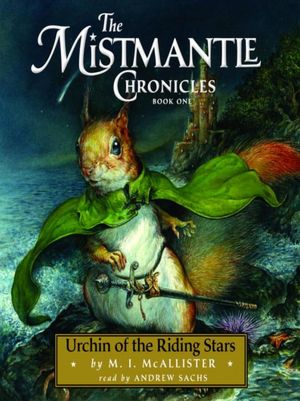
Book Review #14: The Mistmantle Chronicles: Urchin of the Riding Stars
This month's Animal Fantasy Book Review returns to one of my favorite subjects: woodland critters! The Mistmantle Chronicles by M. I. McAllister is a well-loved series with a cast of squirrel, hedgehog, otter, and mole characters. I've seen them on bookstore shelves for years, but I admit I was a bit behind the times in picking one up. With five books in the series, I decided it was high time for me to jump into book one, Urchin of the Riding Stars. Here is the book blurb:
Orphan Urchin never intended to be a swashbuckling squirrel. Abandoned at birth on a Mistmantle beach, this mild-mannered acorn hunter was raised by the island's squirrels, otters, and moles. He gains entrance into the royal court, thanks to the support of his hero, the dashing Captain Crispin. But something is wrong in the peaceful kingdom of Mismantle. Under the influence of the squirrel captain Husk, the King is enforcing severe measures against his people. Crispin himself is falsely accused of a horrific murdered and banished.
Can little Urchin, a mere smidgen squirrel, defend his master and his people?
First off, I want to dispel a misconception. While the cover of this book contains a sword-wielding squirrel and the plot involves forest animals fighting for the home they love, this is NOT a Redwall knock-off. Yes, there are many similarities between the two, and since Brian Jacques' pioneered this realm of animal fantasy, it's hard not to compare them. But I can happily say that Mistmantle is not more of the same, but rather something else for lovers of animal fantasy to enjoy. While there are many aspects I liked about the book, I most admired McAllister's writing style and world-building techniques which makes her series stand out in a crowd of woodland critter novels.
One of the first things readers will notice about Mistmantle is how pleasurable and easy it is to read. Now don't get me wrong: I LOVE Jacques' Redwall books. That being said, I sometimes find them just a teensy bit long-winded. (Please don't hit me!) I certainly wouldn't claim that Mistmantle is for a younger readership or pre-Redwall audience, though; the writing is just as beautiful, and the plot is just as engaging and complex. Mistmantle simply proves that sometimes less is more. I was pleased to find that the plot moved swiftly and didn't get bogged down in unnecessary details or characters. With today's readers (and array of electronic distractions), this is becoming increasingly important. If you write animal fantasy, you should definitely see how McAllister crafts a compelling, adventurous, and epic story without using 400+ pages.
In addition to writing a great story, McAllister also created a delightful, unforgettable world. World-building is so important in any fantasy story to help the reader connect with the story. The Isle of Mistmantle is home to lovable creatures with a distinctive culture. The chapters are filled with careful details on what the inhabitants eat, believe, fear, celebrate, wear, use for medicine, etc. Further, the book contains words unique to the woodland culture, such as the Riding Stars (their term for a meteor shower) and Threadings (tapestries). The mix of details and specific terms brings such a richness to the Mistmantle world, making the reader want to return as soon as they turn the last page. (I know I did!)
If you love animal fantasy books, then Mistmantle is a sure-fire winner for you. If you write animal fantasy, this is a fantastic book to study, and one you'll definitely enjoy reading, too. And if you're a die-hard fan of Jacques' work and convinced this is just a Redwall copycat, I ask you to give Mistmantle a chance. (I think you'll be pleasantly surprised.)
You can find out more about McAllister and the entire Mistmantle series on her website here: margaretmcallister.co.uk.
And if you read this book, do let me know! I'd love to hear what you think. :)
Happy reading!
Note: Summary blurb is from barnesandnoble.com. Cover art is from McAllister's website, noted above.
Orphan Urchin never intended to be a swashbuckling squirrel. Abandoned at birth on a Mistmantle beach, this mild-mannered acorn hunter was raised by the island's squirrels, otters, and moles. He gains entrance into the royal court, thanks to the support of his hero, the dashing Captain Crispin. But something is wrong in the peaceful kingdom of Mismantle. Under the influence of the squirrel captain Husk, the King is enforcing severe measures against his people. Crispin himself is falsely accused of a horrific murdered and banished.
Can little Urchin, a mere smidgen squirrel, defend his master and his people?
First off, I want to dispel a misconception. While the cover of this book contains a sword-wielding squirrel and the plot involves forest animals fighting for the home they love, this is NOT a Redwall knock-off. Yes, there are many similarities between the two, and since Brian Jacques' pioneered this realm of animal fantasy, it's hard not to compare them. But I can happily say that Mistmantle is not more of the same, but rather something else for lovers of animal fantasy to enjoy. While there are many aspects I liked about the book, I most admired McAllister's writing style and world-building techniques which makes her series stand out in a crowd of woodland critter novels.
One of the first things readers will notice about Mistmantle is how pleasurable and easy it is to read. Now don't get me wrong: I LOVE Jacques' Redwall books. That being said, I sometimes find them just a teensy bit long-winded. (Please don't hit me!) I certainly wouldn't claim that Mistmantle is for a younger readership or pre-Redwall audience, though; the writing is just as beautiful, and the plot is just as engaging and complex. Mistmantle simply proves that sometimes less is more. I was pleased to find that the plot moved swiftly and didn't get bogged down in unnecessary details or characters. With today's readers (and array of electronic distractions), this is becoming increasingly important. If you write animal fantasy, you should definitely see how McAllister crafts a compelling, adventurous, and epic story without using 400+ pages.
In addition to writing a great story, McAllister also created a delightful, unforgettable world. World-building is so important in any fantasy story to help the reader connect with the story. The Isle of Mistmantle is home to lovable creatures with a distinctive culture. The chapters are filled with careful details on what the inhabitants eat, believe, fear, celebrate, wear, use for medicine, etc. Further, the book contains words unique to the woodland culture, such as the Riding Stars (their term for a meteor shower) and Threadings (tapestries). The mix of details and specific terms brings such a richness to the Mistmantle world, making the reader want to return as soon as they turn the last page. (I know I did!)
If you love animal fantasy books, then Mistmantle is a sure-fire winner for you. If you write animal fantasy, this is a fantastic book to study, and one you'll definitely enjoy reading, too. And if you're a die-hard fan of Jacques' work and convinced this is just a Redwall copycat, I ask you to give Mistmantle a chance. (I think you'll be pleasantly surprised.)
You can find out more about McAllister and the entire Mistmantle series on her website here: margaretmcallister.co.uk.
And if you read this book, do let me know! I'd love to hear what you think. :)
Happy reading!
Note: Summary blurb is from barnesandnoble.com. Cover art is from McAllister's website, noted above.
Friday, October 26, 2012
COSCBWI October 2012: Overcoming Obstacles with Rae Carson
This month's COSCBWI meeting was a real treat, featuring author Rae Carson! Rae is the Ohioana award-winning author of The Girl of Fire and Thorns and the recently released sequel, The Crown of Embers. She led our group in a discussion on overcoming obstacles throughout the publication process--a situation many authors face throughout their careers. She didn't focus on the common obstacles (such as scoring an agent or learning to write a winning query letter), but instead shared her perspective on deep-rooted and often unpredictable road blocks.
Some of the obstacles she brought to light included:
The Inability to Complete Projects
-There are lots of reasons and excuses why writers never finish projects
-Writers may get bored, outgrow an idea, or simply give up when the going gets tough
Outside Expectations of Failure
-Writers often face a lack of support and understanding from non-writers (even family and friends)
-With the odds stacked against writers, many people just expect you to fail
-Writers may face resentment by loved ones due to the time and attention they dedicate to writing
Economics
-Money necessities often make writing difficult
-Job demands may force your writing to the back-burner
-The costs of conferences and networking can be a strain on your wallet
Not Writing Good
-Sometimes you learn that your writing stinks even though you thought it was awesome
-Sometimes when you learn your writing stinks, you want to crawl into a hole and pretend you don't exist
Really Crappy Luck
-Sometimes bad things happen and there's not much you can do about it
-Timing can be everything (i.e., you write an awesome ninja book and one is published the next day)
-Sometimes your feedback can be so contradicting, you don't know what to do at all
I don't know about you, but I find this list 100% accurate! While these obstacles may seem a little depressing, Rae assured us there were things we could do to avoid and overcome them. She advised us to hone our craft and attend classes, workshops, and conferences as much as possible. She also said that sometimes it may be necessary to re-think your target audience, re-write a novel, or even get a second agent. If you don't find support at home, seek out writing friends who understand what you're going through (and can offer critique feedback, too!) And of course, she told us to never EVER give up!
A big thanks to Rae for coming in to speak to COSCBWI! You can learn more about her and her books at www.raecarson.com. (I just loved The Girl of Fire and Thorns and can't wait to read the sequel!)
You can learn more about COSCBWI and our upcoming events at www.coscbwi.org. I hope to see you at our next monthly meeting! :)
Tuesday, October 23, 2012
Belated Art News: 2013 Calendar Results
![]() |
| Updated jaguar: now with more jaguar-ish spots! |
D'oh! Remember this post about the Northern Ohio SCBWI 2013 calendar contest? Well, I completely forgot to let you know the results!
Voting took place during the conference a few weeks ago, and I'm pleased to say my entry made it into the 2013 calendar! You can see all the winning pieces on the Northern Ohio SCBWI website here. There were a lot of really great entries this year, and I'm very honored that my piece was selected. (You can find instructions for purchasing a calendar through the above link, too. It's a good way to support a wonderful organization!)
I can't wait to see everyone's art in the finished calendar! :)
Wednesday, October 17, 2012
Fall Update
Apologies AGAIN for the lack of posts around here. It's been Tax
Season 2 at my office--and this year was brutal. (I'll never understand
why so many people wait until the absolute last minute to do their
taxes! Grrrr.....) Fortunately, the filing deadline was October 15th, so I can put
that behind me now and get back to my life again! :)
Quick reminder: don't forget that the COSCBWI fall workshop is coming up
on October 27th! (It doesn't even conflict with the OSU game!) Our speakers, editor Kristin Ostby, and author-illustrator Lindsay Ward have some great presentations planned. You can
still sign up at http://coscbwiworkshop.wildapricot.org/. Don't wait, though--registration ends soon!
Now it's time to nap, play a little catch up, and get back to my writing, reading, art, and blogging again!
Note: image is (c) Microsoft clipart
Thursday, October 4, 2012
COSCBWI Sept. 2012: Show, Don't Tell!
Big apologies for my delay in posting the COSCBWI September meeting summary! Goodness, it's been a busy few weeks!
September's meeting featured our Regional Advisor, Linda
Miller. Linda led the group in a discussion on the oh-so important
topic, "Show, Don't Tell." This is something writers hear often, but what
does it mean?
Linda explained that there are many ways writers can "tell" their
stories. Common signs of "telling" include blunt prose, a lack of
description, and information dumps. For example:
Six-year-old Timmy loved sports. He couldn't wait for his big
soccer game tonight. He wondered if he would make a goal. He also
wondered if his dad would come. Dad often had to work a lot, and
sometimes he missed important things, like Timmy's games and other
after-school activities.
Yawn. Big yawn.
There's nothing wrong with that paragraph; it's just not very
interesting, is it? You probably wouldn't want to read an entire book
written like that. (And you can bet kids won't, either.)
To fix
this problem, Linda said to remember your action words and adjectives. (Instead of, "he walked," perhaps use "scurried" or "raced" or "trudged.") You can also use inferences so the reader understands information without it being shouted at them. (i.e. "It was winter," can be inferred by writing, "The snow was falling.") Lastly, she went over the 5 senses and how their use can help paint a more vivid picture for your reader.
When you consider the many options you have to jazz your writing up, you can rework your story accordingly. For example:
Timmy bounced in his seat as Mrs. Brown wrote subtraction
problems on the chalkboard. He couldn't focus on math--not when he had a
big game tonight! His team, the Mighty Tigers, were on a winning
streak, and sure to beat the Sunnydale Elementary Blue Jays. The
chalkboard faded as he thought back to last week's game. He'd run
across the field in a black and orange blur, scoring not one, but two
goals! Everyone cheered, and his mom shouted from the bleachers.
Timmy's stomach flipped when he remembered the empty seat beside
her. Dad had missed the game--and the two before that. "Sorry,
kiddo. I have a big business meeting. But I'll be there next time, I
promise," Dad had said. Timmy sighed, wondering if he would actually
keep his promise this time.
The same information is conveyed that was in the first example,
but now Timmy is a more developed and dimensional character. The reader wasn't told every
fact, but came to the same conclusions based on the implied
information. (i.e. The empty seat showed Dad missed the game, while the first version just told us that his Dad worked a lot.) Before, the reader didn't feel close to Timmy or the facts about him, but now he's a character kids can relate to. When the reader
is emotionally invested in the story, they keep turning the page. And
THAT is our number one goal as writers.
Of course, you don't want to use every one of the methods at the same time to "show" instead of "tell," but peppering them in will certainly make your story shine. Just choose the techniques that work best in your scene. And if you're having trouble, read lots of books! All that pretty prose from professional authors will rub off on you in no time. :)
You can find out more about COSCBWI's upcoming events at: www.coscbwi.org. And don't forget: registration is now open for our October 27th Fall Workshop featuring editor Kristin Ostby and author/illustrator Lindsay Ward. You can register at http://coscbwiworkshop.wildapricot.org/.
Hope to see you at our October meeting AND Fall Workshop!
Subscribe to:
Posts (Atom)